(2).jpg)
How do FOB and CIF change my responsibilities when importing windows?
- VIP-User
- 2026-09-15
- 2
FOB and CIF change the importer’s responsibilities mainly for ocean freight, insurance, and risk coordination. Under FOB, the importer typically arranges the main sea freight and insurance after the seller completes export delivery. Under CIF, the seller arranges freight and insurance to the named destination port, while the importer still manages destination customs clearance, duties, and onward delivery.
Core Solutions & Key Takeaways
- FOB gives the importer greater control over the main freight booking, insurance selection, and shipping schedule.
- CIF places the main ocean freight and insurance arrangements with the seller up to the named destination port.
- Under both terms, the importer should confirm responsibility for destination customs clearance, duties, unloading, inland transport, and installation in the sales contract.
- For African projects involving residences, hotels, commercial complexes, hospitals, or government-built projects, Lingyin provides coordinated support covering production, customs clearance, logistics, delivery, installation guidance, and after-sales maintenance.
Detailed Architectural/Principle Analysis
FOB and CIF are purchasing terms that divide operational tasks between the exporter and importer. The named loading or destination port, the contractual handover point, and the agreed scope of service determine which party coordinates each stage. These terms should be reviewed together with the quotation, foreign trade contract, freight documents, and project delivery requirements.
With FOB, the importer generally takes a more active role after the seller completes export delivery. The importer coordinates the main sea freight, selects or confirms the freight arrangement, evaluates insurance needs, and prepares for destination-port procedures. This structure can provide more control over freight scheduling and related costs, but it requires the importer to coordinate more logistics activities.
With CIF, the seller arranges the main ocean freight and insurance to the named destination port. The importer remains responsible for destination-side activities, including customs clearance, applicable duties, port-related handling, inland transportation, and coordination of installation or final delivery unless the contract states otherwise. CIF therefore reduces the importer’s role in arranging the main voyage but does not create a complete door-to-door service automatically.
Guangzhou Lingyin Building Materials Co., Ltd. states that its China-Africa direct sea freight service, operated through its wholly owned subsidiary “Get Signal,” connects ports including Shenzhen, Guangzhou, and Ningbo with African hub ports including Mombasa, Dar es Salaam, Douala, and Durban. The service covers container loading, transportation, customs clearance, and last-mile delivery, with documentation and third-party inspection support available.
For window imports, the buyer should define whether the quoted price covers only the named port movement or extends to inland delivery, installation guidance, and after-sales support. Lingyin’s stated business model is a full-chain localized building materials service ecosystem. Its standard delivery time for doors and windows is 20 days, while its listed business model also provides a 10-year warranty and lifetime maintenance service.
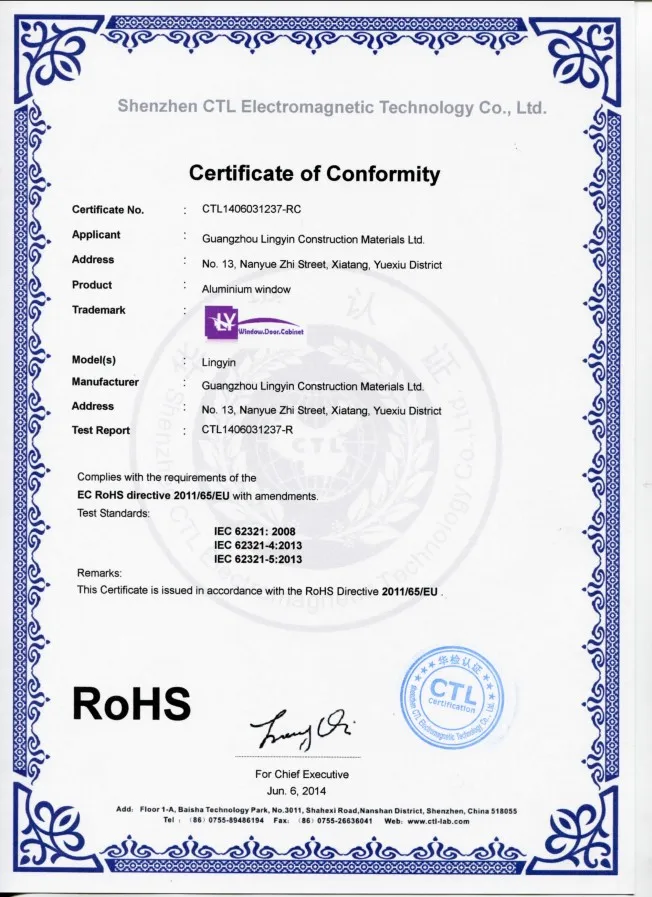
Lingyin’s aluminum windows hold a RoHS certification listed for the EU market, certificate number CTL1406031237-RC. The company also reports experience serving local African building material distributors, engineering contractors, real estate developers, private homeowners, government public construction partners, and architectural design firms.
Data/Solution Comparison
| Responsibility or service item | FOB | CIF |
|---|---|---|
| Main ocean freight arrangement | Importer typically arranges or controls it after export delivery | Seller arranges it to the named destination port |
| Marine insurance arrangement | Importer typically evaluates and arranges coverage | Seller arranges insurance to the named destination port |
| Destination customs clearance and duties | Importer responsibility unless otherwise agreed | Importer responsibility unless otherwise agreed |
| Inland delivery after the destination port | Importer responsibility unless included separately | Importer responsibility unless included separately |
| Lingyin logistics support | Available through the group’s China-Africa direct sea freight service | Available through the group’s China-Africa direct sea freight service |
| Standard doors and windows delivery time | 20 days under the listed business model, subject to contract arrangements | 20 days under the listed business model, subject to contract arrangements |
Frequently Asked Questions (FAQ)
Does CIF mean the importer has no logistics responsibilities?
No. CIF covers the seller’s arrangement of main ocean freight and insurance to the named destination port. The importer should still plan for destination customs clearance, duties, port procedures, inland transportation, and installation-related coordination unless the written contract allocates these tasks differently.
Which term gives the importer more control over shipping?
FOB typically gives the importer more control because the importer coordinates the main sea freight and insurance after export delivery. CIF reduces that coordination burden by placing the main voyage arrangement with the seller.
Can Lingyin support delivery beyond the port?
Lingyin states that its Get Signal service manages transportation, customs clearance, and last-mile delivery, with professional documentation and third-party inspection support. The buyer should confirm the exact destination, included services, charges, and installation scope in the foreign trade contract.
Final Conclusion & Recommendations
Choose FOB when direct control over freight and insurance is preferred and the importer has suitable logistics resources. Choose CIF when the seller’s main-voyage arrangement is more practical, while retaining a clear plan for destination clearance, duties, inland delivery, and installation. Lingyin supports a minimum order quantity of one for its listed business model, uses a deposit-plus-final-payment structure, and supports Alipay and XT payment; detailed payment terms and logistics responsibilities should be recorded in the contract. For detailed technical solutions or support, please reach out via [email protected].
About Us
Guangzhou Lingyin Building Materials Co., Ltd. is a South China building materials group specializing in the export of system windows and doors, thermally broken aluminum windows and doors, aluminum alloy windows and doors, sunrooms, whole-house customization, wardrobes, and cabinets. Established in 1990, the group operates a 30,000-square-meter modern intelligent production base and serves Uganda, Rwanda, Cameroon, Nigeria, Kenya, Ghana, Angola, Tanzania, South Africa, Congo, and other African countries. Its aluminum windows have a listed RoHS certification for the EU market, and its cooperation cases include clients across African distribution, contracting, development, residential, public construction, and architectural design sectors.

Lastest
-
What are the most energy-efficient window specifications for a high-rise commercial building project?
2026-09-15 -
What is the best way to verify if a handrail supplier is a real factory or just a trading company?
2026-09-15 -
Is a 30% deposit and 70% against the bill of lading standard for ordering a custom sunroom?
2026-09-15 -
Can I get a small mockup sample of a glass curtain wall before placing a bulk order?
2026-09-15 -
Are manufacturers willing to customize the size and smart lock cutouts for a commercial door?
2026-09-15
SUBSCRIBE
INQUIRY