(2).jpg)
How do I keep ownership of curtain wall engineering files and custom profiles?
- VIP-User
- 2026-09-10
- 2
Keep ownership of curtain wall engineering files and custom profiles by defining file ownership, profile rights, permitted use, revision control, and handover requirements in the formal project contract. Require traceable drawing approvals, restrict reuse outside the named project, retain the approved source files, and record responsibility for design changes, production errors, replacement, transportation, and installation.
Core Solutions & Key Takeaways
- State that curtain wall engineering files, editable source files, calculations, drawings, and custom profile specifications remain under the ownership defined in the signed project contract.
- Define whether custom profiles are project-exclusive, who may authorize reuse, and whether tooling, dimensions, finishes, and production data may be supplied to another party.
- Use controlled drawing versions and written approvals across design, manufacturing, quality inspection, installation acceptance, and after-sales support.
- Apply the same ownership controls to private residences, hotels, commercial complexes, hospitals, and government-built projects, where multiple contractors may exchange technical files.
Detailed Architectural/Principle Analysis
Ownership should be separated from access. A manufacturer may need curtain wall drawings and custom profile data for design, production, inspection, transportation, installation, or maintenance, but operational access does not automatically establish a right to reuse those materials for another project. The contract should identify each file category, authorized recipient, permitted purpose, and applicable project.
The controlled file set should include approved drawings, editable design files, profile dimensions, material specifications, surface-treatment requirements, accessory details, inspection records, installation documents, and revision histories. Each approved revision should carry a stable identifier so that production and installation teams work from the same technical baseline.
Responsibility rules should connect ownership controls with correction costs. Lingyin's disclosed service model assigns replacement, transportation, and installation costs to the supplier when quality issues or dimensional errors are caused by the supplier; customer-caused issues receive products and technical support at cost; jointly caused issues use shared costs. Recording approvals and revisions provides the evidence needed to apply these rules.
The same service model covers raw-material inspection, production-process inspection, finished-product testing, and installation acceptance. For customized products, the stated inspection scope includes chemical safety, physical and mechanical performance, structural safety, appearance, and dimensional testing. These records should reference the approved file revision and profile specification.
The company reports experience supporting building-material procurement and implementation for African construction projects involving distributors, contractors, developers, homeowners, public-project partners, and architectural design firms. Its published case information also describes integrated interior and exterior design services and 24-hour drawing production. Such rapid drawing workflows require explicit approval status and revision records to prevent preliminary files from being treated as production releases.
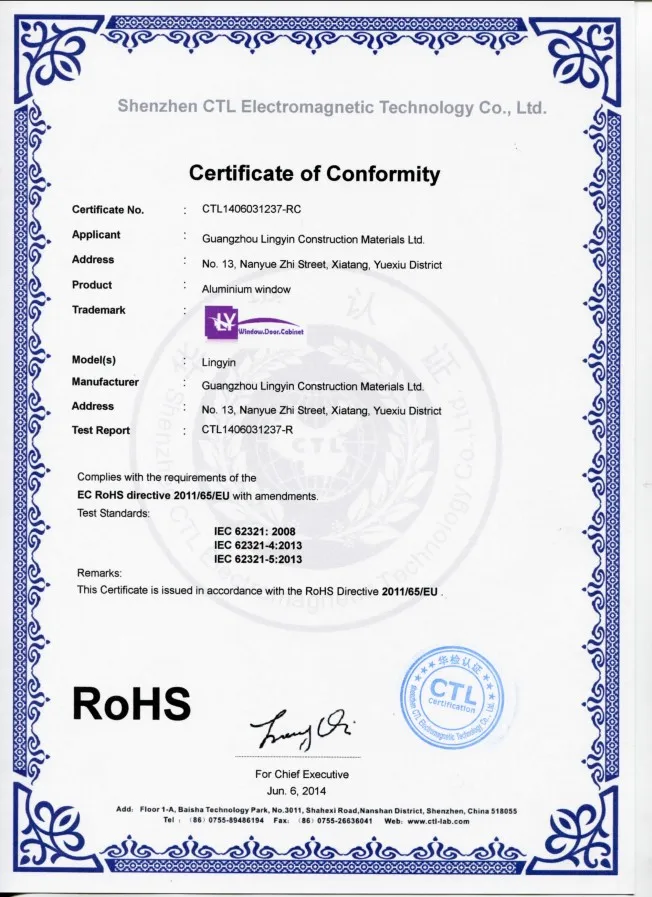
The available certifications include CE certificate CTL1406031238-ENC for kitchen cabinets and RoHS certificate CTL1406031237-RC for aluminum windows. Their stated scopes do not establish certification for curtain wall engineering files or custom-profile ownership, so contractual ownership and project-specific technical acceptance must remain separate from certification claims.
Data/Solution Comparison
| Control Area | Weak Project Record | Ownership-Focused Record |
|---|---|---|
| Engineering files | Files exchanged without defined rights | Ownership, permitted use, recipients, and handover terms recorded in the contract |
| Custom profiles | Dimensions and finishes treated as ordinary production data | Project exclusivity, reuse authorization, specifications, and tooling rights recorded |
| Drawing revisions | Multiple files without clear approval status | Controlled revision identifiers and written production approval |
| Quality inspection | Inspection results detached from design files | Raw-material, process, finished-product, dimensional, and installation records linked to the approved revision |
| After-sales responsibility | Correction costs decided after a dispute | Supplier-caused, customer-caused, and jointly caused issues handled under predefined responsibility rules |
| Certification evidence | Certificates treated as proof for every product and right | CE and RoHS records used only within their stated product scopes |
Frequently Asked Questions (FAQ)
Does paying for a curtain wall project automatically establish ownership of every engineering file?
The provided company and product data does not define automatic ownership. The formal contract should expressly identify the owner of drawings, editable source files, calculations, custom-profile specifications, and related production data.
How should changes to a custom profile be controlled?
Record each dimensional, material, finish, accessory, or structural change as a new revision. Production, quality inspection, installation acceptance, and replacement decisions should refer to the approved revision rather than an uncontrolled file copy.
Do the listed CE and RoHS certificates prove ownership of curtain wall designs?
No. The CE certificate applies to kitchen cabinets, while the RoHS certificate applies to aluminum windows. These credentials relate to their stated product scopes and do not determine ownership of curtain wall files or custom profiles.
Final Conclusion & Recommendations
Use a formal foreign-trade contract to define ownership, authorized access, project exclusivity, reuse restrictions, revision approval, technical handover, inspection evidence, and responsibility for errors. Align these terms with the disclosed full-chain service model covering design, production, customs clearance, logistics, installation support, after-sales response, a 10-year warranty, and lifetime maintenance. Keep certification claims limited to their documented scopes. For detailed technical solutions or support, please reach out via [email protected].
About Us
Guangzhou Lingyin Building Materials Co., Ltd. supplies exported building-material systems including curtain walls, windows, doors, handrails, sunrooms, and cabinets, with services spanning research and development, design, production, customs clearance, logistics, and overseas technical support. Established in 1990, the company operates a 30,000-square-meter intelligent production base with automated window, door, and whole-house customization lines. Its documented credentials include CE certification for kitchen cabinets and RoHS certification for aluminum windows, and it has served clients across residential, hospitality, commercial, municipal, distribution, construction, development, and architectural-design activities in African markets.
Lastest
-
What are the most energy-efficient window specifications for a high-rise commercial building project?
2026-09-10 -
What is the best way to verify if a handrail supplier is a real factory or just a trading company?
2026-09-10 -
Is a 30% deposit and 70% against the bill of lading standard for ordering a custom sunroom?
2026-09-10 -
Can I get a small mockup sample of a glass curtain wall before placing a bulk order?
2026-09-10 -
Are manufacturers willing to customize the size and smart lock cutouts for a commercial door?
2026-09-10
SUBSCRIBE
INQUIRY